How to Write a Haiku: 7 Clear Steps
A practical guide to the three-line form, the familiar 5-7-5 pattern, seasonal detail, vivid observation, and thoughtful revision.


In this guide
Learning how to write a haiku starts with attention, not with a thesaurus. You notice one small event, choose the most precise image, and shape it into a short poem that leaves some space around the meaning. The familiar three-line form gives you a useful boundary, but the image and the turn in thought give the poem life.
This guide explains the traditional 5-7-5 pattern, the difference between English syllables and Japanese morae, the role of a seasonal word, and a repeatable process for drafting and revising. It is written for beginners, classroom writers, journal keepers, and anyone who wants a focused starting point before using an AI haiku generator.
The goal is not to make every haiku sound old-fashioned or identical. A modern English haiku can be quiet, funny, urban, personal, or experimental. What matters is that the short form helps the reader see a moment clearly.
Quick answer
To write a haiku, observe one present moment, collect two concrete images, choose a seasonal or environmental detail, place a pause between the images, draft three short lines, then read the poem aloud and remove explanations. You can use 5-7-5 as a helpful English pattern, but do not sacrifice a precise image just to force a count.
Try the Haiku Poem GeneratorWhat makes a haiku a haiku?
A haiku is a compact poem that presents a moment, image, or observation with very little explanation. In English, it is commonly written as three short lines, often with a 5-7-5 syllable pattern. Traditional Japanese haiku are better described through sound units called morae, so a direct syllable count is not a perfect translation of the original form.
The short shape creates pressure. You cannot explain every feeling, give a full backstory, or name every symbol. Instead, you let a detail carry the emotion. A kettle clicking off, a crow leaving a wet roof, or a child holding a warm stone can suggest more than a paragraph of abstract description.
Many traditional haiku also include a kigo, or seasonal reference, and a kireji-like cut or pause that places two images beside each other. English-language poets adapt these elements in different ways. Treat them as tools for focus, not as a checklist that makes a poem valid only when every box is ticked.

- One moment: Start with something the speaker can see, hear, touch, taste, or remember right now.
- Concrete language: Prefer a wet sleeve, a bus window, or a late moth to a general word such as sadness or beauty.
- A useful pause: Let a line break, punctuation mark, or change of image create a small turn for the reader.
- Room for inference: Trust the image enough to avoid explaining what the reader should feel.
Keep the boundary clear
The haiku poem generator on this site creates a draft. This guide teaches you how to choose the observation, check the form, and revise the language yourself.
The 5-7-5 pattern, syllables, and morae
The pattern most English readers recognize is five syllables in line one, seven in line two, and five in line three. It is a useful exercise because the constraint makes you test every word. It is not a reason to use an awkward phrase. English syllables also vary by accent and pronunciation, which means two careful readers may count a word differently.
Japanese haiku traditionally use seventeen morae, or sound units, arranged five-seven-five. A mora is not identical to an English syllable: a long vowel, a small pause, or a final n can affect the count. When you write in English, say clearly whether you are aiming for a strict syllable pattern, a short three-line poem, or a looser imitation of the form.
Haiku does not require end rhyme. Rhythm comes from line length, pauses, repeated sounds, and the movement between images. If a rhyme appears naturally, keep it; if it pulls attention away from the moment, remove it.
| Element | Beginner-friendly choice | What to check |
|---|---|---|
| Line count | Three lines | Does each line have a clear job? |
| English count | 5-7-5 syllables | Does the wording still sound natural aloud? |
| Japanese count | 17 morae in 5-7-5 | Do not call morae identical to English syllables. |
| Seasonal detail | A plant, weather sign, light, or custom | Does it locate the moment without becoming a label? |
| Cut or pause | Line break, dash, or quiet turn | Do the two images gain energy from sitting together? |
Read aloud before you cut
If the count is correct but your mouth trips over the line, change the wording. A natural sound and a clear image are more useful than a mechanical pattern.
Seven steps for how to write a haiku
A reliable process keeps the form from becoming a blank puzzle. Give yourself raw material first, then make the poem shorter and more exact. The seven steps below work with a notebook, a classroom prompt, or an AI-assisted draft.
Do not wait for a dramatic subject. A small moment is often easier to make specific: steam on a window, a shoe left by the door, a shadow moving across a desk, or the sound of a neighbor closing a gate.
When you use an AI tool, place the observation and the boundaries in the prompt. Ask for alternatives, then keep only the lines that match what you actually noticed.
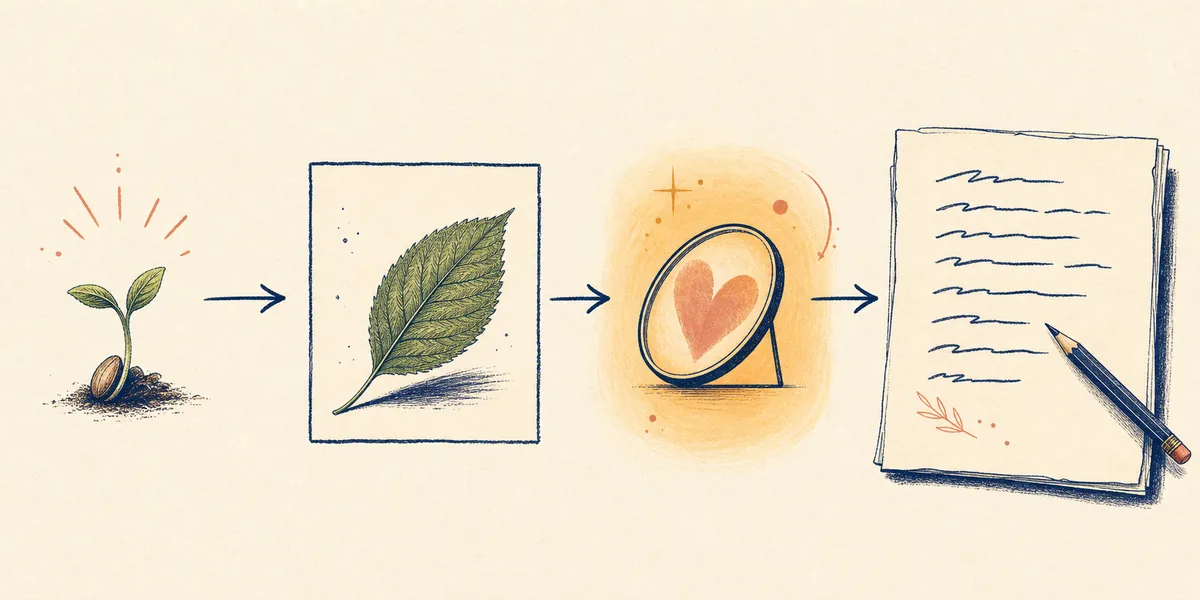
- 1. Notice a small moment: Write down what is happening now, without explaining why it matters. Record the light, sound, temperature, movement, or texture.
- 2. Name the setting: Add one place or environmental clue: a train platform, kitchen sink, school yard, winter path, or city balcony.
- 3. Choose two images: Put two details in conversation. They can contrast, echo each other, or shift from a wide scene to a tiny object.
- 4. Find a seasonal anchor: Use a season, weather change, plant, animal, holiday, or quality of light when it strengthens the moment. Do not add one only to sound traditional.
- 5. Make the cut: Decide where the reader should pause. A line break, dash, colon, or sudden change in scale can create the poem's turn.
- 6. Draft three lines: Write the clearest version first. Then test a 5-7-5 syllable pattern if it helps you remove extra words and sharpen the verbs.
- 7. Read and revise: Read the poem twice, mark vague words, check the sound, and cut any sentence that explains the image instead of letting it work.
A prompt that gives you material
Write a three-line haiku about rainwater gathering in a bicycle bell. Use one seasonal clue, avoid abstract emotion words, and end with a small change in the light.
Haiku examples: from observation to three lines
Examples are most useful when you can see the decision behind them. The first example begins with a literal observation, the second uses a seasonal detail, and the third shows that a modern haiku can take place indoors. These are original examples for practice, not quotations from a historical poet.
Do not copy the lines as a formula. Ask what the poem leaves unsaid, where the pause happens, and which noun carries the emotional weight. Then replace the setting and object with something you have actually seen.
| Starting observation | Three-line draft | Craft choice |
|---|---|---|
| A bird leaves a wet roof | Wet roof after rain / one sparrow lifts the silence / gutters shine again | The final line turns from the bird to the returning light. |
| The first cold morning | First frost on the gate / my hands search for the old latch / breath becomes a cloud | The season appears through touch and breath, not a named emotion. |
| A lamp in a quiet kitchen | Midnight kitchen / the kettle clicks itself awake / one cup catches gold | The small sound creates the cut, while the cup gives the ending a visual landing. |
Check the source
If you cannot point to the observation that started the poem, the draft may have become a general statement. Return to the room, object, or sound and rewrite from there.
How to revise a haiku without flattening it
Revision is where a short poem earns its space. Read the draft as a listener, not as a person defending every word. Look for abstract labels, filler introductions, and adjectives that tell the reader what the image already shows.
Check the line breaks as well as the syllables. A line can be grammatically complete but still feel dull if the break does not create a pause, surprise, or change of scale. Try two or three versions before deciding that the first arrangement is best.
Finally, protect the poem's quietness. A haiku does not need a moral, a grand conclusion, or a declaration of what nature taught the speaker. A small shift in light, sound, temperature, or attention can be enough.
- Circle the nouns: Keep the objects that only this poem could contain. Replace a generic noun with a specific one when possible.
- Underline the verbs: Choose active, observable movement. A precise verb often removes an adjective and makes the line shorter.
- Cut explanations: Delete phrases such as I feel, it reminds me, or this shows that when the image can carry the meaning.
- Test the pause: Move the line break or punctuation and read both versions aloud. Keep the one with the sharper turn.
- Check the ending: Let the final line add an image, echo, or change. Avoid summarizing the poem's lesson.
- Useful question: What can the reader see that the speaker never explains?
- Useful limit: Use one strong image rather than three decorative metaphors.
- Useful test: Read it to someone else and ask which detail they remember first.
Good haiku are not always strict
A natural three-line poem with a clear image can be more successful than a forced 5-7-5 draft. State your chosen boundary, then revise honestly within it.
When to use a haiku generator
A haiku generator can be useful when you have an image but cannot find a first line, when a class needs several structure examples, or when you want to compare calm, playful, and reflective versions of the same prompt. It is best used as a drafting partner rather than as the final author.
Give the tool a narrow input: one object, one setting, one mood, and one constraint. After it returns a draft, check whether the details are true to your prompt, whether the syllable count is plausible in your accent, and whether the ending adds something rather than repeating the theme.
Do not paste private details that you would not want processed by a third-party service. Keep your own notes, rewrite the lines in your voice, and treat generated wording as material for revision.
- Use it for momentum: Ask for three openings or alternate images when the page feels blank.
- Use it for comparison: Try the same observation as a strict 5-7-5 draft and as a looser three-line poem.
- Keep authorship visible: Choose the image, verify the facts of the scene, and make the final cuts yourself.
Next step
If you already have an observation, open the Haiku Poem Generator, start with the sample prompt, and then replace its image with one from your own day.
Frequently asked questions
Helpful references
- Poetry Foundation: Glossary of Poetic Terms - A reference for poetic form, line, image, and sound vocabulary.
- Academy of American Poets: Haiku - Background on haiku history, conventions, and examples.
- Tofugu: Haiku - A clear explanation of Japanese haiku, morae, kigo, and the cut.
Start with one thing you can see
Write down one small moment from today, turn it into two images, and draft three lines before you judge the result. The first version only needs to give you something real to revise.