Poem Ideas: 40 Prompts and Topics for Your Next Poem
A practical list of poem ideas, poem topics, images, and prompt patterns for students, journal writers, card makers, and anyone using AI as a creative starting point.


In this guide
Searching for poem ideas usually means you already want to write, but the first line feels too blank. A broad topic such as love, nature, grief, or friendship can help, but it is not enough by itself. A usable idea gives you a scene, a speaker, a reason to write, and a detail that can carry the poem.
This guide collects practical poetry ideas that work for free verse, school assignments, cards, journal writing, spoken word, and AI-assisted drafting. Use the list as a starting point, then narrow the idea until it feels specific enough to become a poem rather than a theme label.
Quick answer
A strong poem idea combines a subject or topic, a concrete image, an emotional angle, and a small shift. Instead of “write about home,” try “write about the porch light that stayed on after everyone moved away.”
Open the poetry prompt generatorHow to choose a poem idea or topic that is specific enough
Start with a topic, then make it smaller. “Rain” is a topic; “rain tapping on a school bus window after a hard day” is a poem idea. The smaller version gives you sound, place, mood, and a speaker. It also helps an AI poem generator produce lines that do not sound like every other poem about rain.
A useful test is whether you can picture the idea. If the idea is only an abstract word, add one object, one place, or one action. If the idea already has an image, add tension: before and after, what is missing, what changes, or what the speaker finally notices.
- Start with a subject: Choose a topic such as memory, friendship, change, weather, family, courage, a city, or a small object.
- Add a concrete image: Attach the topic to something visible: a chipped mug, late train, empty chair, garden gate, old jacket, or phone screen.
- Choose the feeling: Decide whether the poem should feel tender, funny, uneasy, grateful, restless, hopeful, or restrained.
- Add a turn: Give the poem a movement: the speaker changes their mind, notices a detail, forgives someone, or accepts an ending.
Prompt formula
Write a poem about [subject] using [concrete image], from the point of view of [speaker], with a [tone] mood, ending with [small change].
40 poem ideas and poem topics by theme
Use these poem ideas as seeds, not fixed assignments. Pick one row, then change the image, season, speaker, or ending so the poem feels personal. If you are using AI, paste one idea into the generator and add your own detail before asking for a draft.
The best list is the one you edit. Swap in a real place, a specific name, or an object from your own life. That one change usually makes the poem easier to write.
| Theme | Poem ideas | Best angle |
|---|---|---|
| Memory | A kitchen smell from childhood; a street you no longer visit; a photo with someone cropped out; a song that belongs to one summer | Use one sensory detail and let the memory change in the final stanza. |
| Nature | A tree after a storm; a river at night; first frost on a fence; a bird returning to the same wire | Avoid general beauty; focus on one movement or sound. |
| Love | The ordinary object your partner always touches; a goodbye at a train station; a note hidden in a coat; a quiet apology | Choose a small proof of affection instead of a grand declaration. |
| Friendship | Two bikes outside a store; a joke nobody else understands; the friend who answers late; growing apart without a fight | Let the poem show loyalty, distance, or change through action. |
| School | A pencil before an exam; the last locker cleanout; a classroom after the bell; a book margin filled with notes | Use the setting to show pressure, growth, or transition. |
| Family | A recipe card; shoes by the door; a parent’s hands; the silence after a family story | Let objects carry emotion so the poem does not become sentimental. |
| Identity | Your name mispronounced; a mirror in bad light; a language you understand but rarely speak; the first time you chose your own style | Write from the inside of a small moment. |
| Change | Boxes in a hallway; a calendar page; a haircut after a breakup; a road you finally take alone | Show what remains and what is left behind. |
| Objects | A cracked phone screen; a key with no door; a winter coat in summer; a cup with a faded logo | Treat the object as a witness, not just decoration. |
| Imagination | A city under the ocean; a letter from the moon; a dream where houses move; a clock that forgets time | Give the strange image one human feeling. |
Turn a poem idea into a first draft
Once you have a topic, do not start by chasing perfect language. Start by listing material: images, verbs, sounds, and contradictions. A poem grows faster when you give yourself raw parts to arrange. This is also where AI can help, because you can ask for several possible openings without accepting the whole poem unchanged.
A simple process is enough: choose the idea, write five concrete details, decide who is speaking, draft six to twelve lines, then revise the ending. The draft does not need to rhyme unless the form requires it.
Go deeper by asking who is speaking and who the poem addresses. The same topic changes when the voice speaks to a friend, a younger self, or a lost object.
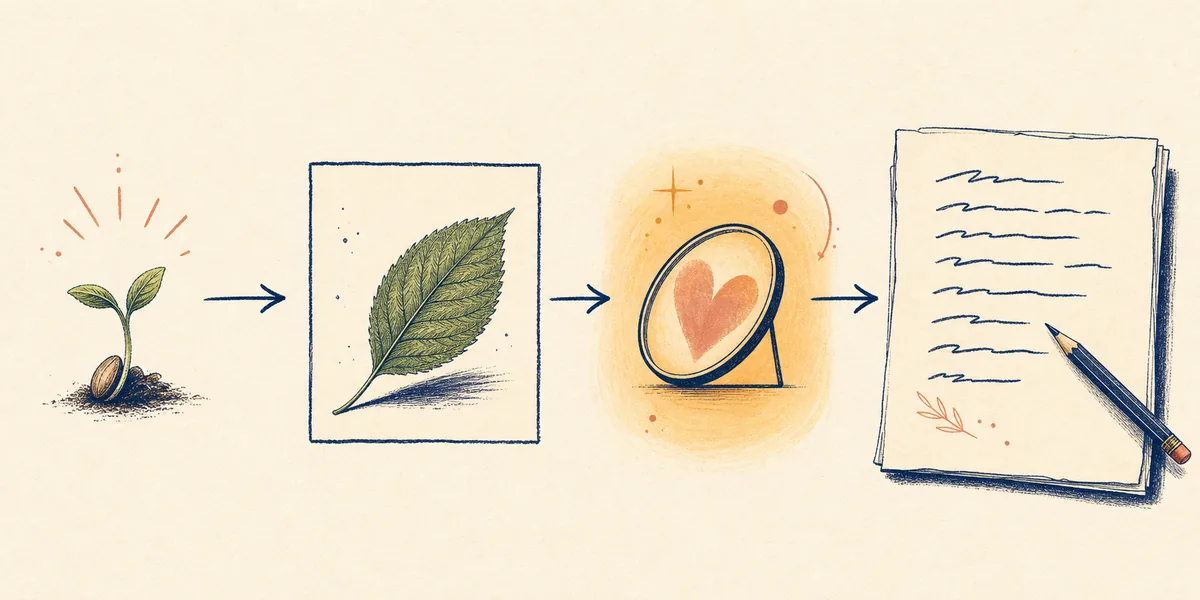
- Collect details: Write five nouns, three verbs, two sounds, and one contrast connected to the idea.
- Choose a speaker: The speaker can be you, a fictional voice, the object itself, or someone looking back years later.
- Draft small: Write six to twelve lines before worrying about title, rhyme, or final structure.
- Revise the turn: Make the last third of the poem reveal a change, question, or sharper image.
Match your idea to the right poetry form
Some ideas need room; others improve when the form is strict. If the idea is emotional and personal, free verse often works best. If the idea is for a school task, a visible form such as haiku, acrostic, sonnet, or ballad makes the structure easier to explain.
Do not force rhyme onto an idea that wants clarity. A strong free verse poem can be more memorable than a weak rhyming poem. Use form as a tool, not a decoration.
For a school assignment, connect the idea to a form: haiku for one image, acrostic for one word, and ballad for a small action. You can then explain why the structure fits the idea.
| Idea type | Good form | Why it fits |
|---|---|---|
| A single image or season | Haiku | The short form keeps attention on one clear moment. |
| A name, word, or classroom display | Acrostic | The first-letter structure gives the poem a visible frame. |
| A love, apology, or tribute poem | Free verse or sonnet | Free verse sounds natural; a sonnet adds formal weight. |
| A story or memory with scenes | Ballad or narrative poem | The form lets the poem move through events. |
| A funny or playful idea | Limerick | The rhythm supports surprise and humor. |
How to avoid generic poem topics
Generic poems usually come from generic prompts. Words like love, hope, sadness, dreams, and nature are useful starting points, but they become weak when the poem never leaves the abstract idea. Add a scene, a body detail, an object, or a decision.
Before you finish, remove any line that could fit almost any poem. Replace it with a detail only this speaker could notice. This is the fastest way to make a poem idea feel original.
Keep a small bank of personal details: places, sounds, gestures, objects, and overheard phrases. This bank makes an idea more concrete before you open a generator.
If you use AI, do not enter only the topic. Add an image, tone, form, length, and a boundary such as no clichés, no forced rhyme, or no overdramatic ending.
For a personal card, avoid a topic that is too broad. Name a memory, place, or shared habit so the poem sounds less like a template.
During revision, read the draft aloud. Cut lines that sound attractive but show nothing new, then replace them with an action or image.
When you have several ideas, do not automatically choose the most dramatic one. The idea with the clearest image and a small real tension often becomes concrete lines faster.
After the draft, mark the strongest line and rebuild the other lines around it. That gives the idea a clear center instead of leaving it as a topic.
- Replace labels: Change “I feel lonely” into “the second cup stayed clean on the shelf.”
- Use verbs: Instead of naming a mood, show what the speaker does: folds a note, waits at a window, deletes a message.
- Limit big symbols: Stars, hearts, oceans, and light can work, but only if tied to a specific scene.
- End with a turn: Let the final lines shift from description to realization, decision, or unanswered question.
Revision rule
Keep the line that belongs only to this poem. Cut the line that could appear in any poem.
Frequently Asked Questions
Helpful references
- Poetry Foundation: Glossary of Poetic Terms - Useful for checking forms, devices, and poetry vocabulary.
- Poets.org: Materials for Teachers - Helpful classroom poetry activities and prompt inspiration.
Start with one image
Pick one idea from the table, add one real detail from your life, then generate or draft a short poem before judging it.