How to Create a Poem with AI Without Losing Your Own Voice
A practical guide for turning a rough idea into a poem with AI: choose the form, write a better prompt, revise the draft, and keep the final poem personal.

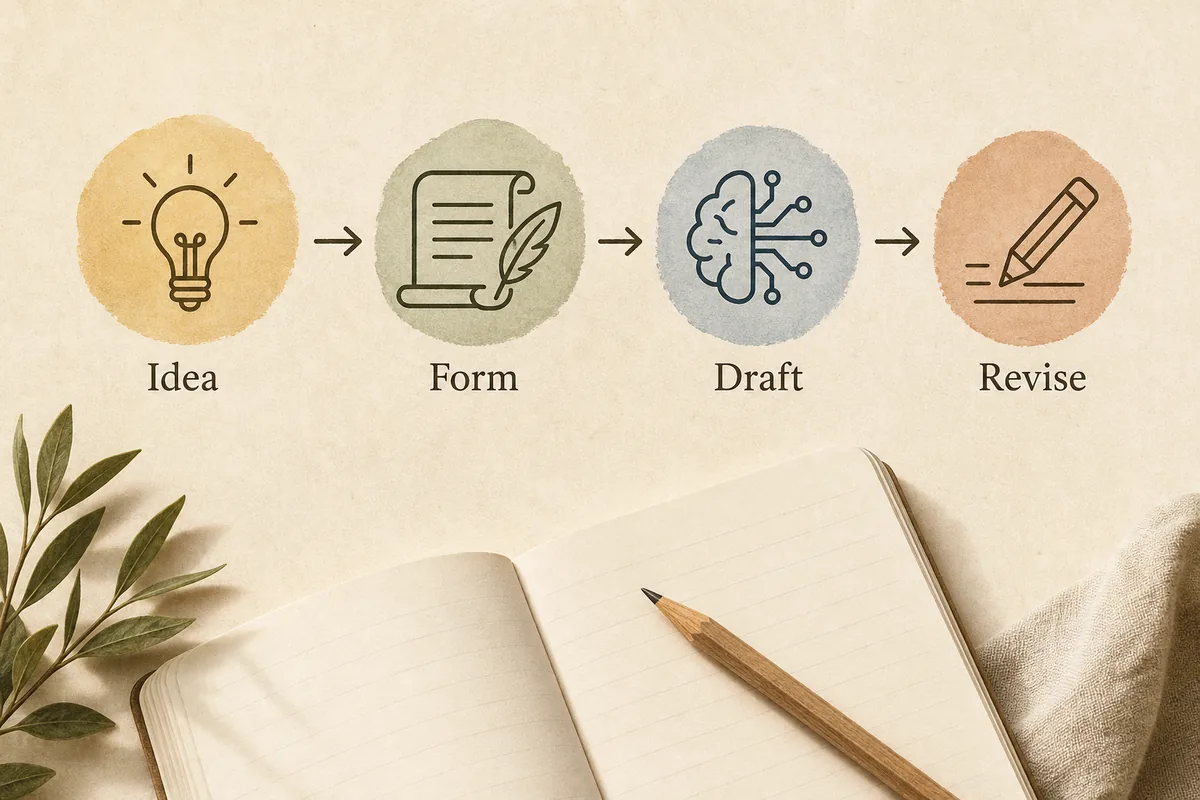
In this guide
You can create a poem with AI in a few seconds, but a useful poem still needs direction. The difference between a flat AI poem and a memorable one is usually not the model; it is the brief you give it and the revision you do afterward.
This guide is for students, card writers, creators, and anyone who wants an original poem without staring at a blank page. It does not replace your judgment. It gives you a repeatable workflow: define the idea, choose the form, generate a draft, then revise the poem until it sounds intentional.
Quick answer
To create a strong AI poem, write one sentence for the occasion, one concrete image, the desired tone, the poem form, and one thing to avoid. Generate a draft, then revise the opening line, remove generic phrases, and add one detail only you would know.
Open the free poem generatorStart with a short poem brief
Before opening an AI poem generator, write a brief in plain language. A brief keeps the poem from drifting into generic lines about stars, hearts, silence, and dreams. It also helps you decide whether the result is useful or just polished.
A good brief answers five questions: who is the poem for, what moment is it about, what image should appear, what tone should it use, and what should it avoid. You do not need literary vocabulary. Simple details work better than abstract instructions.
- Occasion: Name the purpose, such as a birthday card, school assignment, wedding toast, journal entry, or short social caption.
- Image: Choose one concrete object or scene: a train platform, a kitchen light, a rainy window, a blue notebook, or a garden path.
- Tone: Use emotional direction such as warm, playful, reflective, hopeful, restrained, humorous, or bittersweet.
- Boundary: Tell the AI what to avoid: no clichés, no forced rhyme, no dramatic language, no religious references, or no romantic tone.
Useful formula
Write: Create a [form] for [reader/occasion] about [theme], using [image], with a [tone] mood, and avoid [things to avoid].
Choose the right poetic form
The form changes the poem more than most prompts do. If you only ask for a poem, the AI often writes a loose inspirational verse. If you name the form, it can control length, rhythm, line breaks, and expectations.
For personal messages, free verse is usually best because it sounds natural. For school exercises, haiku, acrostic, sonnet, limerick, and ode can be easier to evaluate because each has visible constraints.
| Goal | Best form | Why it works |
|---|---|---|
| Personal card | Free verse or short rhyming poem | Flexible, warm, and easy to personalize |
| Name or word activity | Acrostic poem | Each line follows a letter, so the structure is clear |
| Nature moment | Haiku or short free verse | Forces attention to one image and a small turn |
| Formal assignment | Sonnet or ode | Gives structure, argument, and a clear subject |
| Funny greeting | Limerick | Uses rhythm and surprise without needing a long poem |
Write a prompt AI can actually use
A strong prompt gives the AI materials, not just a command. Instead of writing “make a beautiful poem,” give the model a scene, reader, mood, form, length, and revision instruction. This makes the first draft closer to what you need.
If you are using the free AI poem generator, keep the prompt compact. Put the most important information at the beginning. Then use the style and mood controls to reinforce the request.
- Good prompt: Write a 12-line free verse poem for my sister’s graduation. Use the image of a train leaving at sunrise. Make it proud and gentle, not sentimental. Avoid clichés about wings.
- Better prompt for a school poem: Create an acrostic poem using COURAGE for a middle-school presentation. Each line should show a small action, not a slogan. Keep vocabulary clear.
- Prompt to revise: Rewrite this poem to sound more natural. Keep the central image, remove generic lines, and make the ending quieter.
Revise the AI draft so it sounds personal
Do not treat the first AI poem as finished. The first draft is a scaffold: it gives line breaks, possible images, and a direction. Your revision turns that scaffold into a poem that feels chosen.
Start with the first and last lines because they shape the reader’s memory. Then remove words that could appear in any poem: soul, endless, forever, whispers, dreams, heart, and light are not wrong, but they become weak when they appear without a specific reason.
- Replace abstract emotion: Change “I miss you deeply” into a visible detail, such as “your mug still waits beside the kettle.”
- Cut duplicate lines: If two lines say the same feeling, keep the more concrete one.
- Read aloud: A poem that looks elegant may still sound stiff. Reading aloud reveals awkward rhythm and forced rhyme.
- Add one personal detail: A place, object, shared joke, or small memory can make the poem harder to imitate.
Revision rule
Keep what only this poem can say; remove what any poem could say.
Prompt examples and use cases
Different situations need different prompts. A romantic poem should not sound like a school exercise; a school poem should not sound like a private letter. Use the prompt as a small creative contract.
You can also generate only a prompt first when you want to write the poem yourself. That keeps the creative work in your hands while still solving the blank-page problem.
| Use case | Prompt direction | Recommended tool |
|---|---|---|
| Need a complete poem fast | Give occasion, reader, tone, and form | AI Poem Generator |
| Need inspiration only | Ask for themes, images, and opening lines | Poetry Prompt Generator |
| Need a surprise theme | Ask for a random topic and short draft | Random Poem Generator |
| Need a name poem | Provide the exact name and desired tone | Acrostic Poem Generator |
Frequently Asked Questions
Create your first draft
Start with a small brief instead of a big instruction. A concrete image, a tone, and a reader are enough to get a usable first draft.