How to Write a Poem: 8 Practical Steps for Beginners
A clear, low-pressure process for turning one image or feeling into a finished poem, whether you write free verse, a haiku, an acrostic, or a structured form.


In this guide
If you want to learn how to write a poem, the hardest part is often not vocabulary. It is choosing a small enough moment to explore. “Write about love” is a theme; “the second cup left clean after an argument” is a starting point with an image, a relationship, and a question inside it.
This guide gives beginners a practical path from a blank page to a readable first draft. You can use it for a school assignment, a journal, a card, spoken word, or an AI-assisted draft. The goal is not to follow rules for their own sake. The goal is to make deliberate choices about what the poem notices and how the reader moves through it.
Quick answer
To write a poem, choose one specific subject, collect sensory details, decide who is speaking, select a form that fits, draft without over-editing, then revise the strongest images and sounds. Finish with a title that adds direction rather than repeating the topic.
Find a poem idea1. Understand what you are trying to say
Before writing lines, write one plain sentence about the moment or question behind the poem. This is not the poem itself. It is a private compass. You might write, “I want to show how a familiar house feels different after someone leaves,” or “I want to remember the small courage of getting on a late train alone.”
Do not force a complete message too early. A poem can discover its meaning while you draft. For now, decide what kind of attention you want to give the subject: affection, unease, humor, grief, curiosity, gratitude, or a mixture. A clear emotional direction helps you choose details without turning the poem into an explanation.
- Name the occasion: Decide whether you are writing for yourself, a class, a card, a performance, or a specific person.
- Shrink the subject: Move from a broad word such as change or friendship to one room, object, sound, gesture, or short memory.
- Choose the emotional pressure: Ask what feels unresolved, surprising, funny, tender, or difficult about the moment.
- Keep one open question: Let the poem explore something instead of announcing a lesson in the first line.
A useful starting sentence
I want to write about [specific moment] because [feeling or question], using [one image] to show what changed.
2. Collect concrete material before polishing language
Good poems give abstract feelings a physical place to live. Instead of listing words such as lonely, beautiful, or hopeful, gather the things a person could see, hear, touch, smell, or do. A chipped mug, a hallway light, a bus ticket, or a phone that never rings can carry more feeling than a paragraph of explanation.
Make a small material list before you draft. Include ordinary details as well as one image that does not seem to belong. The unexpected detail may become the poem’s turn. If you use an AI tool for brainstorming, feed it this list rather than asking for a generic poem about your theme.
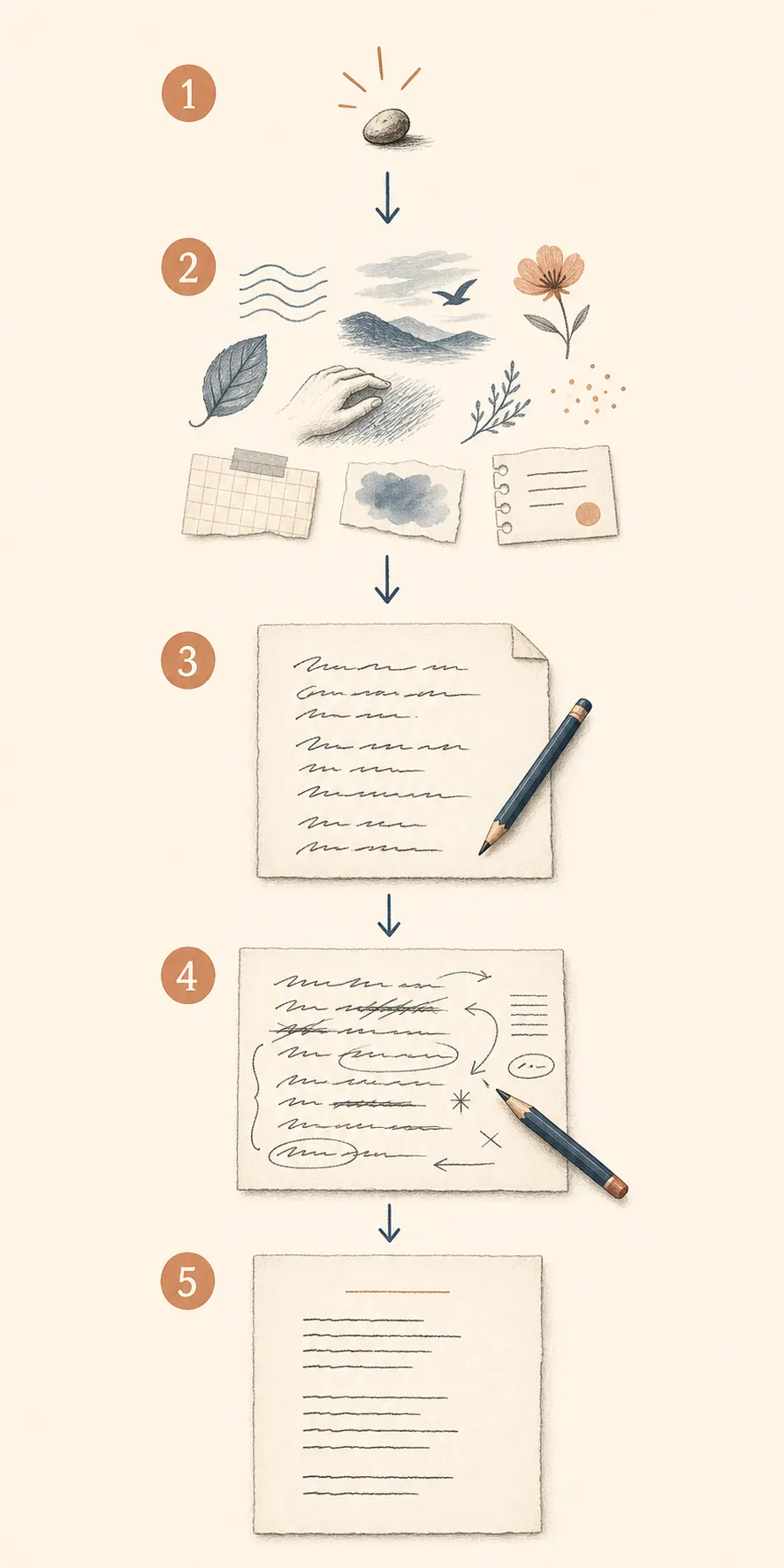
- List five nouns: Write objects, places, people, or natural details connected to the moment.
- Add three active verbs: Describe what the speaker or objects do: fold, wait, scrape, turn, carry, open, or leave.
- Capture two sounds: Notice a repeated noise, a silence, a rhythm, or a word someone says.
- Choose one physical sensation: Use temperature, texture, weight, distance, light, or movement to ground the feeling.
- Keep one contradiction: Pair two truths that do not fit neatly, such as relief and sadness or comfort and embarrassment.
Avoid the abstract-only draft
If every line could describe anyone’s experience, replace one feeling word with a detail only this speaker would notice.
3. Choose a poetry form that helps the idea
You do not need to choose a form before you know what the poem wants to do. Free verse is a useful default when the voice, scene, or emotional movement matters more than a fixed pattern. A structured form can be better when the poem needs compression, repetition, a classroom requirement, or a clear musical frame.
Treat form as a tool rather than a test. If rhyme makes the language sound forced, loosen the rhyme or change the form. If the draft wanders, a short form or repeating pattern may give it useful pressure.
| Form | Good fit | What to watch |
|---|---|---|
| Free verse | Personal scenes, reflection, spoken voice | Use line breaks and images deliberately instead of writing prose with random breaks. |
| Haiku | One image, season, or brief moment | Keep the focus narrow and review syllables without sacrificing natural meaning. |
| Acrostic | A name, word, classroom display, or gift | Make each line contribute meaning; do not let the first letters become the only idea. |
| Sonnet | Love, argument, praise, or a thought that turns | Plan the movement and turn before forcing a rhyme scheme. |
| Ballad or narrative poem | A story with people, scenes, and change | Give the reader action and a reason to care about the ending. |
| Limerick | Playful subjects and comic surprise | Keep the rhythm lively while making the final rhyme serve the joke. |
Form decision
Choose the simplest form that makes the poem clearer. Complexity is useful only when it creates a meaningful constraint.
4. Draft lines and stanzas without stopping every minute
Write a rough opening from the strongest image, not from a general introduction. “The rain was sad” gives the reader a label. “Rain gathered in the cracked bus window where your face should have been” gives the reader a place to look. You can make the line less dramatic later; first give yourself something visible to revise.
Write six to twelve lines before judging the poem. Let the first draft repeat itself, change direction, or contain plain language. The job of a first draft is to create material. The job of revision is to decide what deserves to stay.
- Open with an image or action: Begin where something is happening or being noticed, rather than explaining the entire backstory.
- Vary line length: Short lines can create hesitation or emphasis; longer lines can carry thought, story, or breath.
- Use stanza breaks as movement: Start a new stanza when the scene, time, speaker, or emotional pressure changes.
- Read the draft aloud once: Listen for where your voice slows, rushes, or naturally expects a break.
Drafting rule
Do not solve every line while the poem is still discovering its subject. Mark uncertain lines and keep moving.
5. Revise for image, sound, and clarity
Revision is where a group of lines becomes a poem with intention. Read the draft once for meaning, once for sound, and once for what feels unnecessary. You are not trying to make every line impressive. You are trying to make the poem’s attention consistent and its movement easy to feel.
Start with the places that sound familiar. Phrases about stars, hearts, darkness, dreams, or forever are not automatically wrong, but they need a specific scene to earn their place. Replace a general statement with an action, object, or comparison that belongs to this speaker.
- Cut the warm-up: Remove opening lines that only announce the topic. Start closer to the image or conflict.
- Sharpen verbs: Replace weak forms of be with a physical action when the action changes the picture.
- Check sound: Read aloud and keep useful repetition, internal rhyme, alliteration, or silence; remove accidental awkwardness.
- Protect the turn: Make sure the final third adds a realization, decision, image, question, or change rather than repeating the opening.
- Leave room for the reader: Explain only what the poem needs. A precise image can carry an emotion without a paragraph of interpretation.
Final-line test
After reading the last line, can the reader feel that something moved, even if the poem does not provide a neat answer?
6. Write a title that adds direction
A title can name the subject, point toward a hidden detail, create a question, or frame how the reader should enter the poem. It does not need to summarize every line. Try writing the title last, after you know which image or tension remains most important.
Test three kinds of title: a concrete object from the poem, a short phrase that changes the meaning of the image, and a title that names the situation without explaining it. Avoid a title that simply repeats “A Poem About Love” unless the plainness is an intentional choice.
- Borrow a concrete detail: Use an object, place, or phrase that appears in the strongest part of the poem.
- Try a small tension: Pair two ideas that meet in the draft, such as “The Clean Cup” or “After the Applause.”
- Read title and first line together: The two should create an inviting opening, not say the same thing twice.
Title reminder
A good title opens a door. It does not need to tell the reader what to think once they enter.
7. Use AI as a drafting partner, not a replacement for attention
AI can help when you have an image but not an opening, when you want to compare forms, or when you need several possible endings. It works best when your prompt contains a specific subject, a concrete detail, a reader or occasion, a tone, and a boundary such as “avoid clichés” or “do not force rhyme.”
Keep your own judgment in the loop. Compare the draft with your original material list, remove details that are not yours, and rewrite the lines that sound generic. If you want a structured workflow, the site’s guide to creating a poem with AI explains how to prompt, draft, and revise without losing your voice.
- Give the tool material: Share the image, setting, speaker, tone, and form instead of only naming a theme.
- Ask for options: Request three openings or endings and choose the one that gives you something to revise.
- Fact-check your own voice: Remove invented memories, generic praise, or details that do not belong to the person or occasion.
- Revise after generation: Treat the output as a draft. Add one detail only you know and cut the line that could fit any poem.
A compact AI prompt
Write a [form] for [reader] about [specific moment], using [image], with a [tone] mood. Avoid clichés, forced rhyme, and invented details.
Frequently Asked Questions
Helpful references
- Poetry Foundation: Glossary of Poetic Terms - Useful for checking forms, devices, and poetry vocabulary.
- Poets.org: Materials for Teachers - Classroom resources and exercises that can help turn observation into a draft.
Start with one small image
Choose an object near you, write five concrete details, and draft six lines before deciding whether the poem needs rhyme or a fixed form. Revision begins after you have something on the page.