How to Write a Love Poem That Feels Personal
Turn one real memory, gesture, or shared detail into a poem that sounds like your relationship instead of a borrowed declaration.


In this guide
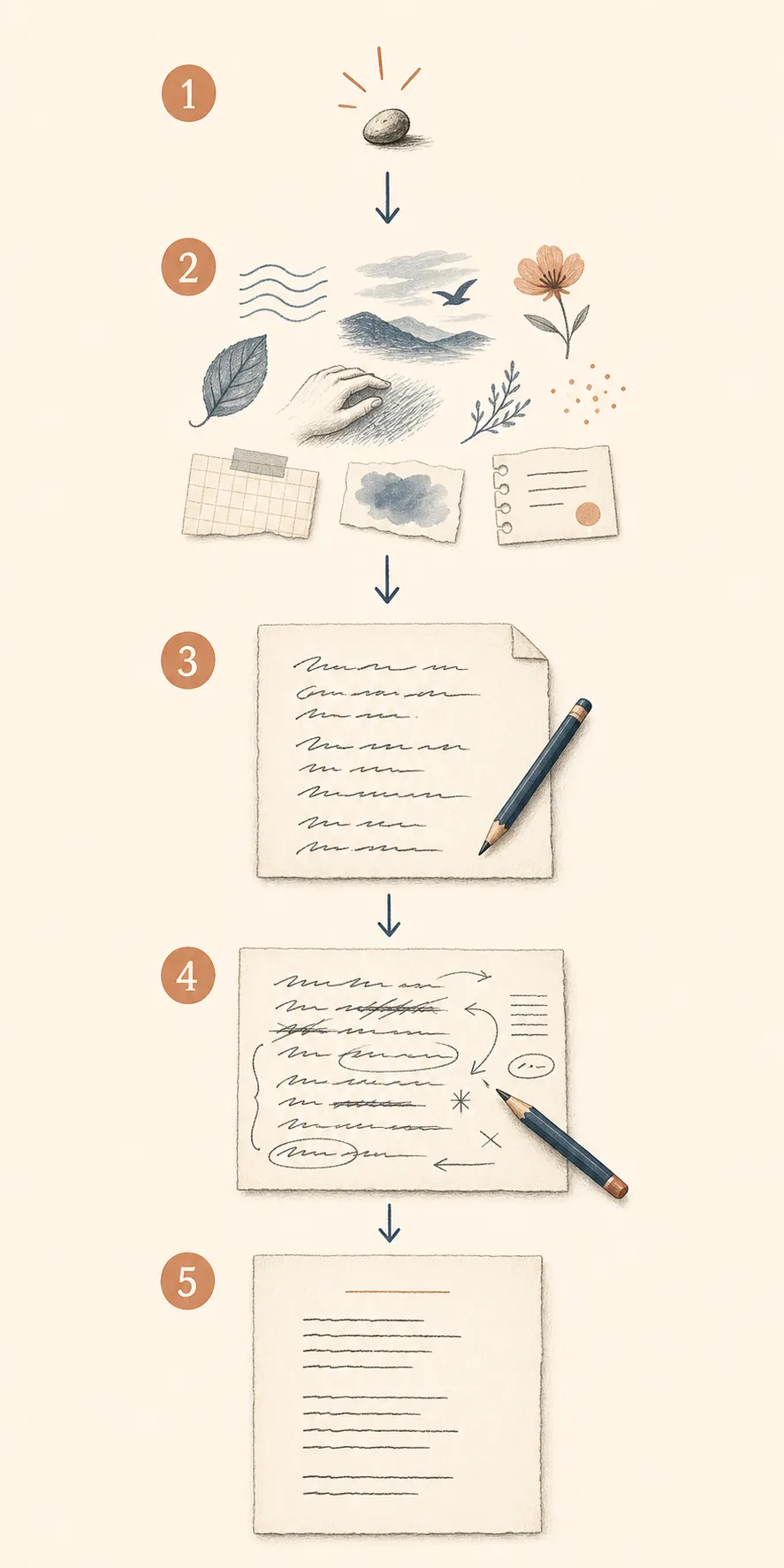
To learn how to write a love poem, start with one person and a moment you can picture. A key turning twice in a sticking lock gives you a scene and a detail that belongs to one relationship. From there, decide what you want to say and where the poem should stop.
These steps work for a short note, anniversary poem, wedding reading, or private draft. You do not need rhyme or a fixed form. Aim for a poem that is honest, clear, and specific to its reader.
Quick answer
Pick one real memory, list sensory details, decide what you honestly want to express, and draft a few lines around the strongest image. Read them aloud, remove borrowed phrases, and keep only details and promises that are true for you.
Use a guided love-poem draft1. How to Write a Love Poem: Start With One Honest Moment
A love poem is easier to write when its subject has edges. Choose a small, memorable moment instead of trying to summarize a relationship: sharing toast, hearing a familiar laugh from another room, or walking home in wet sleeves. It can be joyful, awkward, or unresolved; it only needs to be real enough to recall.
Write one private sentence about why the moment matters. That thought is a compass, not necessarily a line for the poem. If you cannot name the reason yet, describe the scene until a feeling or question appears.
- Name the reader: Decide whether it is for a partner, someone you are newly dating, a wedding audience, or only you.
- Choose a scene: Start with one place, gesture, object, sound, or brief memory.
- Set the purpose: Write a plain note: I want to thank them for making an ordinary morning feel safe.
A useful prompt
Try this sentence: I chose that moment because it matters to me, and this one detail helps show why.
2. Collect details that only you could have noticed
List what you saw, heard, touched, smelled, or did before polishing the language. Add an overlooked detail: a chipped tea cup, a familiar bus route, or the pause before someone tells a well-known story. Particulars show affection instead of asking readers to accept a broad claim.
Keep one or two details that carry feeling. Too many memories turn a short poem into a timeline. Ask whether each detail reveals care, playfulness, distance, or change. If it helps explain why the moment matters, it may earn a line.
- Use the senses: Name a kettle clicking off, a damp sleeve, a familiar footstep, or late light in the room.
- Keep an ordinary detail: A harmless habit can make the portrait believable; do not use a flaw to embarrass someone.
- Protect privacy: Use a memory without exposing a secret or conflict the other person would not want shared.
Specificity test
Could this detail belong to almost any couple? If so, look for a more exact object, action, phrase, or setting that is true to your experience.
3. Decide what you can honestly say
Be warm without promising more than you mean. Decide whether you are thanking someone, celebrating a partnership, expressing a new feeling, missing someone, or acknowledging a mistake. That purpose shapes the voice: a new relationship may call for curiosity, while an apology should name the action before asking for forgiveness.
Do not use a poem to demand a reply or bypass someone's request for space. Before sharing it, consider whether the memory is yours to tell and whether the tone fits the occasion. A private first draft can be more intense than the version you give its reader.
- Use an honest scale: Choose a true sentence over a dramatic claim you would not say aloud.
- Match the setting: A private page can be more vulnerable than a toast or family reading.
- Leave room: Offer the poem as expression, not as a test or demand.
A boundary to keep
Write about what you feel and remember. Do not claim to know what the other person feels unless they have told you.
4. Choose a shape that helps the feeling move
Draft a few lines before choosing a form. Free verse suits ordinary speech and uneven pauses; a short lyric can hold one scene and a turn. A sonnet offers a fixed pattern, while an acrostic can frame a name. Form is a tool, not a measure of affection.
Rhyme is optional. Use repeated sounds, a refrain, line breaks, or rhythm if they help. Read a card or speech aloud and leave room to breathe. A short poem can feel complete when its image and final thought have done their work.
| Shape | When it may fit | Choice to make |
|---|---|---|
| Free verse | A direct voice, varied pace, or one vivid scene | Where a pause or line break changes the emphasis |
| Short lyric | A card, note, or single remembered moment | Which image should carry the ending |
| Fixed form | A deliberate pattern or a poem built around a turn | Whether the rules support your meaning rather than distract from it |
5. Draft the poem in words you would actually use
Arrange the details simply: begin with the scene, show what you noticed, then reveal what it means now. Or start with a feeling and let a memory complicate it. Read as yourself, not in an invented romantic voice; a phrase you would never say aloud may not belong on the page.
Write freely before solving rhyme, title, or line breaks. After a short break, mark the lines that sound like you and remove borrowed details. A poem can stay simple; the work is choosing what is true and giving it room.
- Place the scene: Give the reader a setting, action, or object to picture.
- Trust the detail: Show what you noticed before explaining the emotion.
- Make a turn: Return to the first image with new meaning or end on a thought the details have earned.
A small drafting rule
For the first draft, keep the image and action. Let rhyme and decoration wait until you know what the poem is about.
6. Revise for warmth, clarity, and a natural voice
Read the poem aloud. Replace greeting-card phrases and broad praise with an action or image. Remove adjectives that repeat what a detail shows. Keep line breaks that create a useful pause, and make sure the ending sounds deliberate when spoken.
Use the before-and-after examples below: the first line names a familiar feeling; the second gives it a scene. Personal writing is not a contest for unusual metaphors. An ordinary object described honestly can be more affecting than dramatic language.
| First version | More personal direction | Why it changes |
|---|---|---|
| You make every day brighter. | You leave the hallway lamp on when my bus runs late. | A visible action gives the feeling a place and a reason. |
| I will love you forever. | I still save you the window seat on the train. | A specific present-tense choice can be more honest than an absolute promise. |
Revision question
Does each line add an image, sound, action, thought, or change? Keep what contributes; cut what only repeats the emotion.
7. See how a small detail can become a love poem
This invented example starts with a shared kitchen detail. The draft selects a few parts and lets the last line turn toward what they mean. Change the objects and voice to match your experience; do not copy details that are not yours.
Starting note: We make tea after late shifts. They always rinse the chipped blue mug and leave it beside the kettle for me. I feel remembered in a small, ordinary way.
Draft: The kettle clicks off. / Your blue mug waits by the sink, / handle turned toward the door. / I come home tired, / and find the quiet kept warm.
The example offers a place, action, object, and change in feeling. Revise anything that does not sound like you; choosing a truer detail is part of the process.
Keep the example honest
The sample is fictional. Use it to study how detail and order work, not as a template for someone else's private memory.
Frequently Asked Questions
Helpful references
- Poetry Foundation: Glossary of Poetic Terms - A reference for checking form and poetry terminology when you want a fixed structure.
Start with a detail you can picture
Write down one shared moment and five concrete details. Draft six lines before deciding whether the poem needs rhyme, a fixed form, or a title.